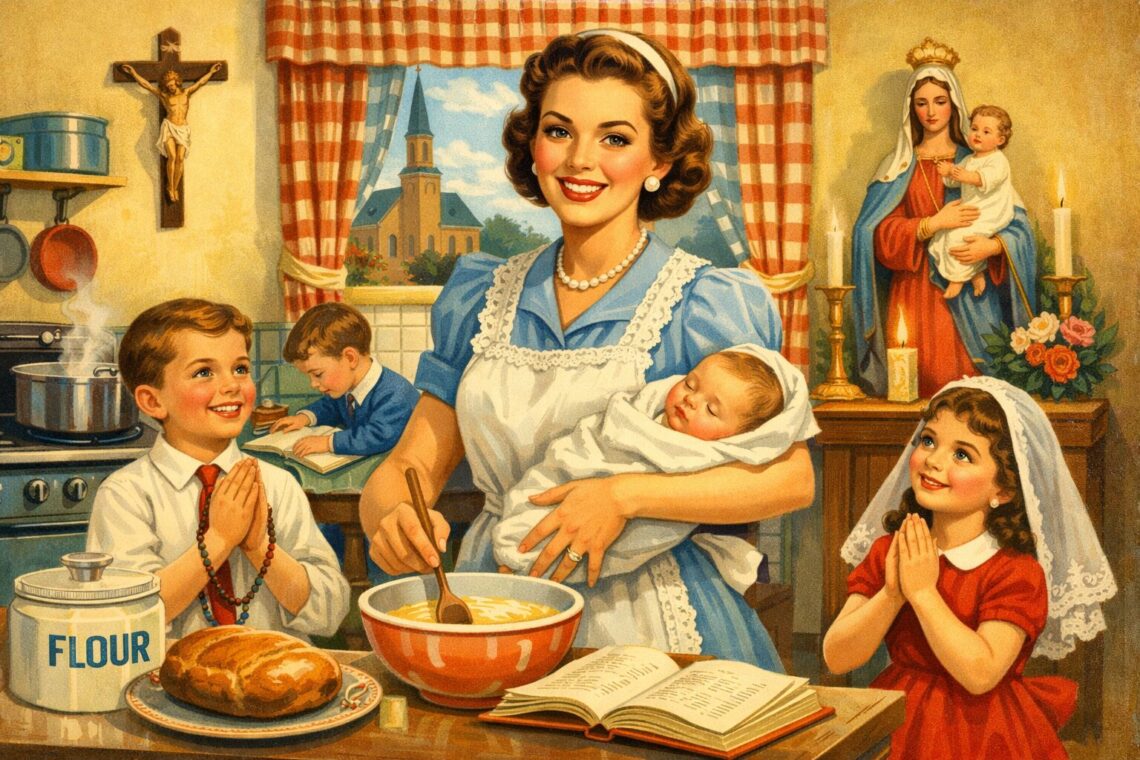
There is a silent standard many Catholic mothers carry.
She wakes before dawn to pray the Rosary in perfect recollection.
Her children never misbehave in Mass.
She homeschools in linen dresses.
Her house smells faintly of beeswax and sourdough.
She never raises her voice.
She never loses patience.
She never doubts.
And she certainly never feels overwhelmed.
This woman exists everywhere online — and nowhere in real life.
The “perfect Catholic mom” is not a vocation. She is a myth.
And if we are not careful, we will begin measuring our holiness against an illusion.
Where Did This Idea Come From?
In part, it comes from good desires.
Catholic mothers want to be faithful. We want to raise saints. We want our homes to reflect order, beauty, and devotion. There is nothing wrong with admiring women who seem organized, disciplined, and spiritually vibrant.
But somewhere along the way, inspiration turns into comparison.
Social media amplifies curated moments. We see prayer corners bathed in morning light. Handwritten Latin copywork. Five children kneeling quietly in perfect rows. A mother who seems endlessly serene.
What we do not see are the meltdowns before Mass. The resentment on no sleep. The unfinished laundry. The spiritual dryness. The arguments in the car.
Holiness has been aestheticized.
And that is dangerous.
The Church Never Asked You to Be Her
The Church does not canonize women for having spotless kitchens.
She canonizes women for heroic virtue.
Look at the actual lives of saintly mothers:
Saint Monica — whose son rejected the faith for years before converting. Saint Gianna Beretta Molla — a working mother and doctor who lived in the modern world. Saint Zelie Martin — who struggled with illness, grief, and the death of children.
These women were not serene caricatures.
They were tired. They were stretched. They suffered.
They also loved fiercely and chose God again and again in the middle of ordinary life.
The Church’s vision of holiness is not performance. It is perseverance.
The Pressure Catholic Mothers Feel
Many Catholic mothers carry three heavy expectations at once:
Spiritual perfection – Daily Rosary, daily Mass, perfect reverence, perfect discipline. Domestic excellence – Homemade meals, clean home, organized life. Cultural defense – Protecting children from a chaotic world while forming them intellectually and spiritually.
That is not a small load.
And when something slips — when the Rosary is rushed, when Mass is chaotic, when tempers flare — guilt arrives immediately.
But guilt is not always from God.
Conviction is specific and gentle.
Shame is vague and crushing.
There is a difference.
Even the Holy Family Was Not “Perfect” in the Way We Imagine
Consider Virgin Mary.
She was sinless — yes.
But she still experienced confusion (“How shall this be?”), fear (fleeing to Egypt), and anguish (losing Jesus in the Temple for three days).
Holiness did not mean emotional ease.
It meant trust.
And consider this carefully: even Jesus grew in wisdom and stature (Luke 2:52). Growth implies process. Development. Time.
Your children’s sanctity will unfold over decades — not because you executed motherhood flawlessly, but because you remained faithful.
The Hidden Pride in “Perfect”
Sometimes the desire to be the “perfect Catholic mom” is not only fear.
Sometimes it is control.
If I do everything right, my children will never stray.
If I follow the formula, nothing will go wrong.
If I am disciplined enough, I can guarantee outcomes.
But salvation is not manufactured.
It is grace.
Your job is not to engineer saints.
Your job is to love them toward Heaven.
You cannot out-manage free will.
Even God allows it.
What Faithful Catholic Motherhood Actually Looks Like
It looks like:
Whispering “Jesus, help me” through clenched teeth. Apologizing to your child when you lose patience. Bringing a toddler back into Mass for the third time. Teaching your child to pray even when you feel spiritually dry. Choosing confession instead of quitting.
It looks like returning.
Again and again.
Faithful motherhood is not a curated aesthetic. It is a thousand small sacrifices offered quietly.
And most of them will never be seen online.
The Real Standard
The real standard is not aesthetic perfection.
It is love.
“By this all men will know that you are my disciples, if you have love for one another.” (John 13:35)
Your children will not remember whether your liturgical crafts matched the calendar.
They will remember:
Did you pray with them? Did you forgive them? Did you speak about God as Someone real? Did you love their father? Did you repent when you failed?
Sanctity grows in homes where humility lives.
If You Feel Like You’re Failing
You are not alone.
If your Rosary is inconsistent.
If your temper isn’t perfect.
If your home isn’t Instagram-ready.
If your children ask hard questions.
If your faith feels stretched thin.
You are not disqualified.
The myth of the “perfect Catholic mom” thrives in comparison.
The real Catholic mother thrives in grace.
God did not choose you for motherhood because you were flawless.
He chose you because He knew you would keep turning back to Him.
And that is holiness.
A Quiet Reframing
Instead of asking:
“Am I doing this perfectly?”
Ask:
“Am I turning toward Christ today?”
That question is achievable.
That question is humble.
That question builds saints.
Not overnight.
But over time.
And that is how Heaven is formed — not through perfection, but through faithful love
God bless

