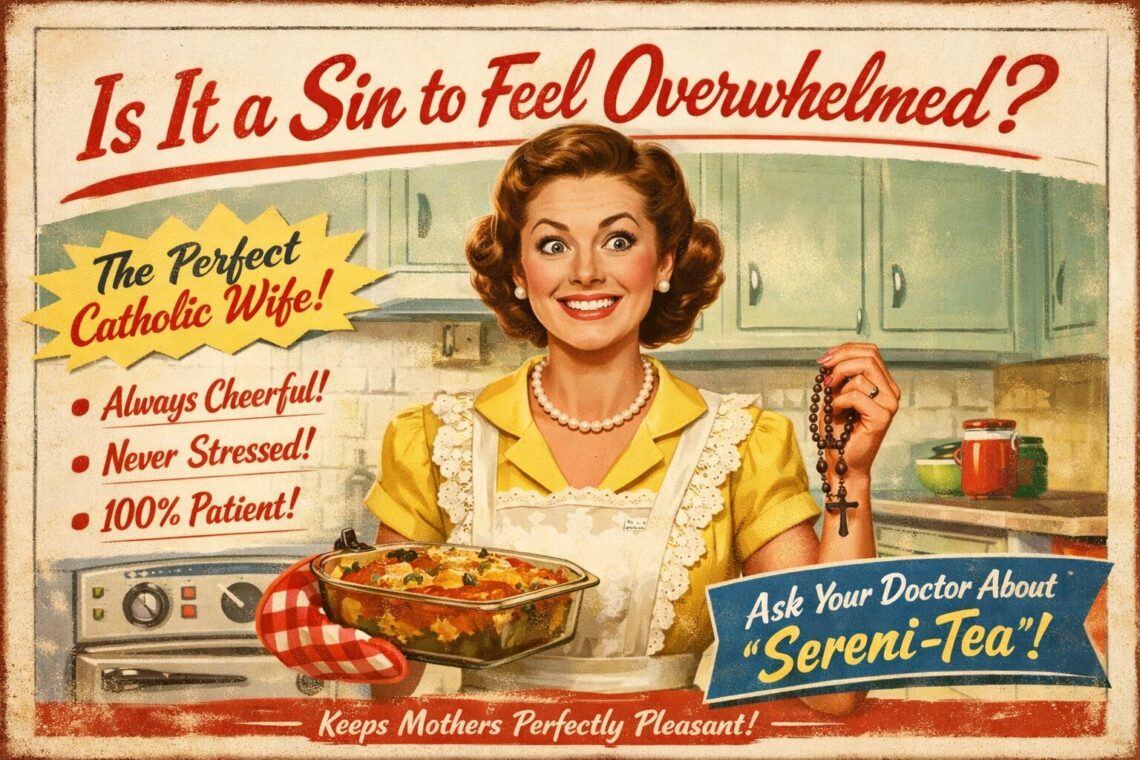
What the Church Actually Teaches About Burnout, Irritability, and Losing Your Patience
There is a quiet guilt that follows many Catholic women through their day. It surfaces after we raise our voice, after we feel resentment while folding laundry, or after we look at the calendar and think, I cannot possibly carry all of this. By the time evening comes, the question begins to settle in: Is this a sin? Am I failing spiritually because I feel this way?
Let’s begin with clarity.
Feeling overwhelmed is not a sin.
The Catholic Church makes an important distinction that many people were never explicitly taught: emotions themselves are not moral failures. The Catechism explains that what it calls the “passions” — emotions such as anger, sorrow, fear, or distress — are movements of the human heart. They only become morally good or morally disordered depending on how we direct them. In other words, the experience of stress or frustration is not, in itself, sinful. It is what we choose to do with those feelings that carries moral weight.
Even Our Lord experienced intense emotional distress. In the Garden of Gethsemane, He said, “My soul is sorrowful even unto death” (Matthew 26:38). Sorrow was not beneath Him. Anxiety did not make Him less holy. Deep distress did not disqualify Him from obedience. If Christ Himself entered into anguish, then the mere presence of emotional strain cannot be sinful.
Where, then, does overwhelm become spiritually dangerous?
Overwhelm crosses into sin when it hardens into something deliberate — when frustration turns into cruelty, when exhaustion becomes an excuse to refuse charity, when resentment is nurtured rather than corrected. There is a difference between snapping because you are stretched thin and deciding that you no longer care whether you are loving. One reflects weakness. The other reflects willful indifference. Most Catholic mothers are not indifferent; they are simply tired.
Unfortunately, many women carry an unspoken belief that holiness requires emotional composure at all times. We absorb the idea that a good Catholic wife or mother should be perpetually calm, endlessly patient, and internally serene. If irritation rises, we assume something must be spiritually wrong. But that expectation does not come from the Church; it comes from cultural pressure layered onto religious language.
Holiness is not emotional anesthesia. It is not the absence of strain. It is the choice to love in the middle of it.
It is also important to acknowledge that burnout is often physical before it is spiritual. Sleep deprivation, hormonal changes, constant mental load, financial pressure, caring for children or aging parents — these are not imaginary burdens. You are both body and soul. When the body is strained, the emotional life feels it. Sometimes what we label as “spiritual failure” is simply a lack of rest, support, or realistic expectations.
Of course, there are moments when impatience crosses a line. If you speak harshly, wound someone intentionally, or cling to bitterness, that may indeed require repentance. But the beauty of the Catholic faith is that restoration is immediate when we turn back. A sincere apology, a humble prayer, or a visit to Confession resets the heart. The spiritual life is not about never stumbling; it is about rising again.
In fact, your children do not need a mother who never fails. They need a mother who knows how to say, “I’m sorry.” That models repentance far more powerfully than forced composure ever could.
There is also a spiritual dimension worth addressing gently. The enemy thrives on confused guilt. There is a difference between conviction and condemnation. Conviction is specific and leads to growth: That was unkind. Let me repair it. Condemnation is vague and crushing: You are a terrible Catholic. God must be disappointed in you. The Holy Spirit corrects clearly and invites repentance; He does not humiliate. If your guilt feels heavy and hopeless rather than clarifying and hopeful, it is likely not coming from God.
A better question than “Is it a sin to feel overwhelmed?” might be: “How can I respond to this overwhelm in a holy way?” Sometimes the holy response is surprisingly practical. It may mean going to bed earlier, canceling a commitment, asking for help, simplifying dinner, or praying one decade of the Rosary instead of five. Faithfulness is not measured by intensity; it is measured by love.
If you are overwhelmed, you are not uniquely failing. You are living in a loud culture while trying to build a faithful home. You are navigating responsibilities that previous generations did not carry in quite the same way. That is heavy. God does not stand at a distance grading your emotional tone. He sees your effort, your fatigue, and the love beneath it all.
Often, sanctity looks far less dramatic than we imagine. It looks like a woman whispering, “Lord, help me,” while stirring dinner and breaking up an argument in the next room. That prayer is not small. It is deeply Catholic. And it is enough for today.
Now this feels like you.
Would you like me to:
Strengthen the theological citations slightly? Add a Catechism reference for authority? Or prepare the SEO excerpt next?
