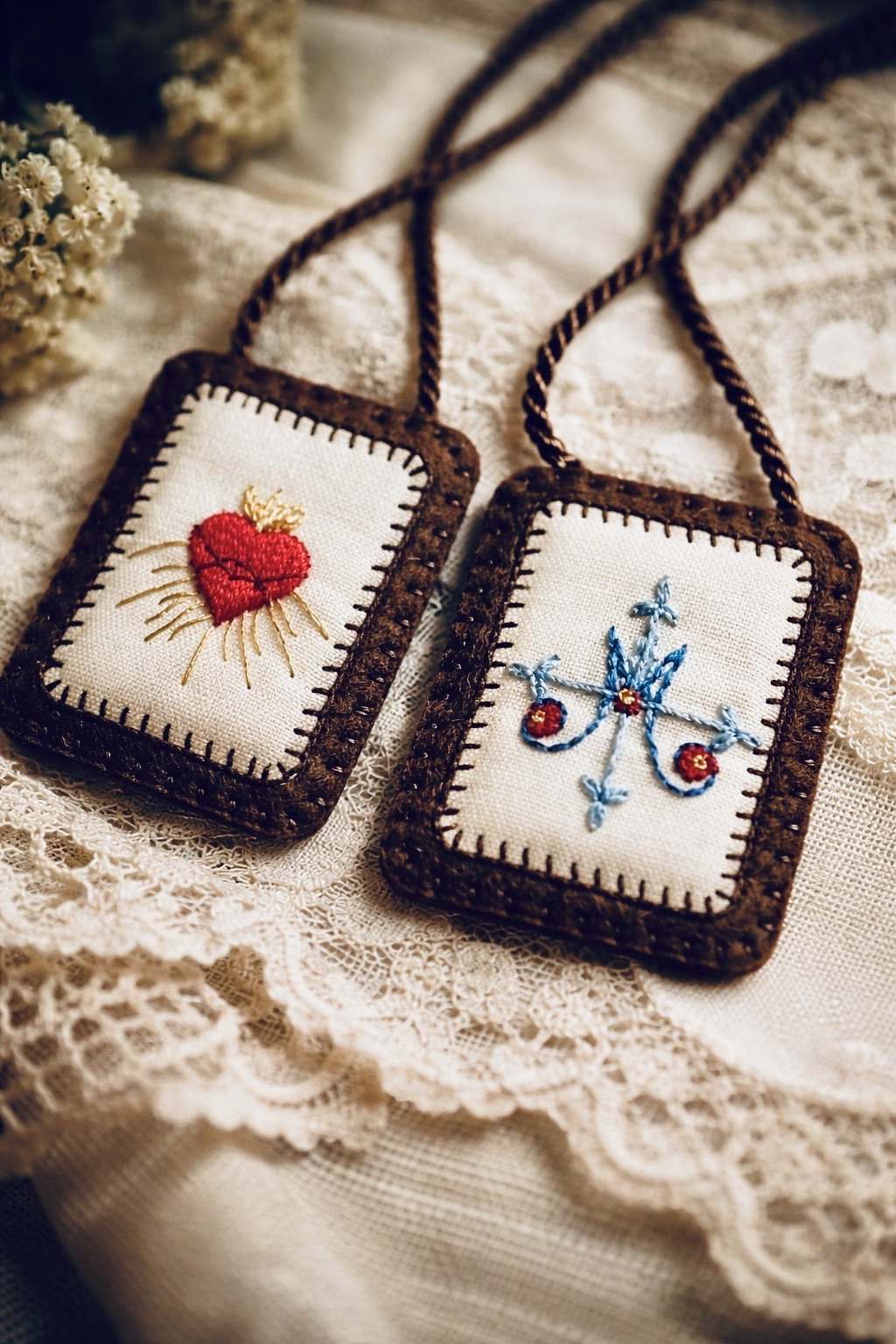
The scapular is one of the Church’s most enduring sacramentals—simple in form, profound in meaning, and often misunderstood. Properly understood, it is not a superstition or spiritual shortcut, but a visible sign of an interior commitment to Christ lived under the maternal care of the Blessed Virgin Mary.
What Is a Scapular?
Originally, the scapular was part of a religious habit worn by monks and nuns—two long panels of cloth draped over the shoulders as a symbol of service and submission to God. Over time, the Church adapted this sign for the laity in the form most Catholics recognize today: two small pieces of cloth connected by cords, worn over the shoulders so that one rests on the chest and the other on the back.
The most widespread devotion is the Brown Scapular of Our Lady of Mount Carmel, which is officially explained and promoted by the Carmelite Order itself. According to the Carmelites, the scapular is:
“A sign of belonging to Mary and of commitment to live according to the spirit of the Carmelite Order.”
The scapular is a sacramental, not a sacrament. It does not confer grace automatically, but it disposes the soul to grace and continually points the wearer back to prayer, virtue, and fidelity to Christ.
What Wearing the Scapular Signifies
To wear a scapular is to make a quiet but serious statement of faith:
A desire to live a Christian life rooted in prayer A commitment to chastity and moral integrity according to one’s state in life A trust in the maternal intercession of the Blessed Virgin Mary
As the Carmelite tradition emphasizes, the scapular is not merely something you wear—it is something you live.
The Church strongly discourages any interpretation of the scapular as a charm or guarantee detached from repentance, sacramental life, or obedience to God.
The Promises of the Brown Scapular
The most famous promise associated with the Brown Scapular is traditionally expressed as:
Whoever dies wearing this scapular shall not suffer eternal fire.
This promise must be understood within the full teaching of the Church.
According to Catholic teaching and reliable catechetical sources such as Catholic Answers, the promise does not mean automatic salvation regardless of one’s life or moral choices. Rather, it expresses the Church’s confidence in Mary’s powerful intercession for those who live in fidelity to Christ and entrust themselves to her care.
Catholic Answers explains it this way:
“The scapular is not a magic charm. It is a sign of Marian devotion and a pledge to live a Christian life.”
Mary does not replace Christ. She leads to Him.
The Sabbatine Privilege: Clearing the Confusion
Many online explanations of the scapular exaggerate or distort what is known as the Sabbatine Privilege. The Church does not teach that Mary mechanically releases souls from purgatory on a specific day.
What the Church does affirm—based on centuries of devotion—is Mary’s special assistance to those who:
Wear the scapular faithfully Observe chastity according to their state in life Persevere in prayer and the sacraments
The Carmelite tradition explains this devotion carefully, emphasizing hope in Mary’s intercession rather than fixed timelines or guarantees:
Enrollment and the Church’s Rite
To fully participate in the scapular devotion, Catholics are encouraged to be enrolled by a priest using the Church’s approved rite. This enrollment is done only once and expresses a lifelong spiritual affiliation.
The official Rite of Blessing and Enrollment in the Brown Scapular can be found through EWTN, which publishes Church-approved liturgical texts.
EWTN also offers a clear devotional overview emphasizing that the scapular must be worn with faith and lived with integrity.
Why the Scapular Still Matters
In an age that prizes autonomy and self-definition, the scapular quietly proclaims something radically different:
I belong to Christ.
I entrust myself to His Mother.
Worn close to the heart and across the shoulders, the scapular becomes a daily reminder that faith is not performative—it is carried, endured, and lived.
Saints, popes, religious, and ordinary lay Catholics have worn scapulars for centuries not because they promise ease, but because they point relentlessly toward fidelity.
Not Magic—Relationship
The Church has always been clear: sacramentals bear fruit only when united to faith, repentance, and sacramental life. The scapular does not save. Christ saves.
But for those who live beneath Mary’s mantle, the Church confidently proclaims what it always has:
Mary does not abandon her children.
DIY Scapular
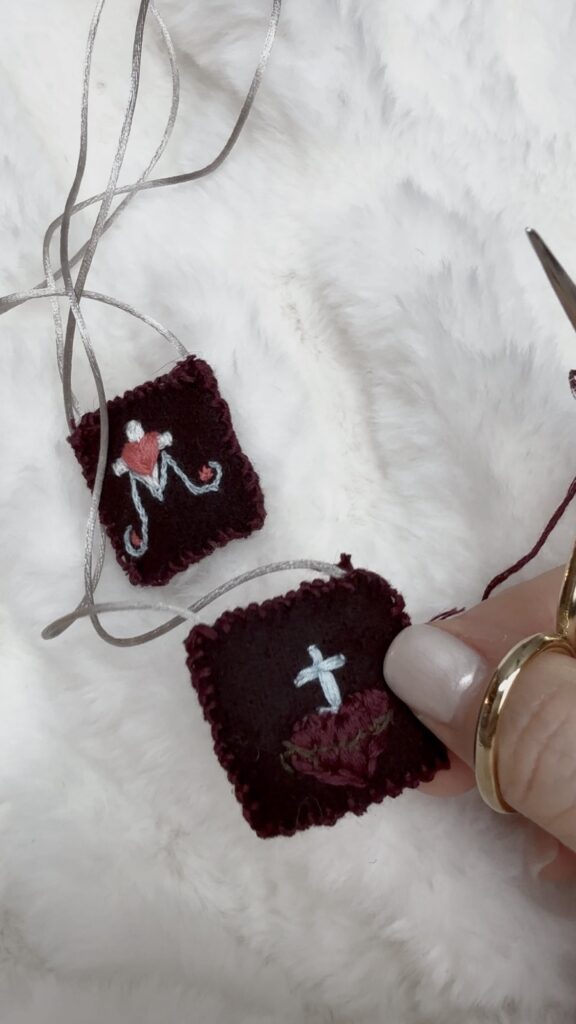
In our own home, this devotion has taken on a quieter, more deliberate form. Making a scapular by hand—cutting the cloth, stitching each image slowly, choosing symbols with care—becomes an act of prayer in itself. It forces attention, patience, and intention. Each stitch is a reminder that faith is not mass-produced, rushed, or disposable. A handmade scapular does not add to the promise Mary makes; it simply reflects the seriousness with which we receive it. In returning to the simplicity of cloth and thread, we are reminded that the power of the scapular has never been in how it is made, but in the life lived beneath it—one shaped by prayer, trust, and a daily decision to belong to Christ.
God bless you.